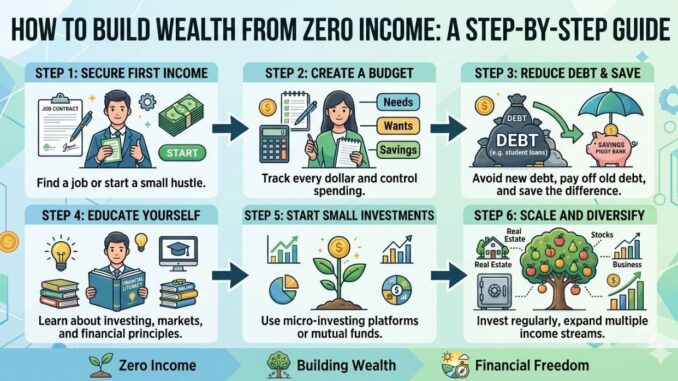
Building wealth when you have zero income feels like trying to start a fire in a rainstorm. However, wealth creation isn’t just about the money you have; it’s about the systems you build and the mindset you adopt.
Here is a comprehensive guide on how to navigate the journey from zero to financial independence.
1. The Psychological Foundation: Mindset Over Money
When you have no income, your greatest asset isn’t your bank account—it’s your time and your perspective.
- The Shift from Consumer to Producer: Most people think about what they can buy. Wealth-builders think about what they can create.
- The Power of Resourcefulness: When you lack resources, you must become resourceful. This means looking at every free tool (libraries, the internet, networking) as a stepping stone.
- Delayed Gratification: You must be willing to live uncomfortably now so you can live uniquely later.
2. Phase One: Survival and “Seed” Capital
You cannot invest if you cannot eat. The first goal is to bridge the gap from zero to a small, consistent surplus.
Sweat Equity
If you have no capital, you must trade labor and time.
- Service-based tasks: Cleaning, moving, freelance writing, or virtual assistance.
- The “Gig” Economy: Utilize platforms that require zero upfront investment to start earning “seed money.”
Extreme Frugality
At this stage, every dollar is a “soldier” that can fight for your freedom.
- Audit every tiny expense.
- Eliminate non-essentials ruthlessly.
- Goal: Create a “gap” between what you earn and what you spend, no matter how small.
3. Phase Two: The Skill Acquisition Phase
Wealth is the byproduct of value. To increase your income, you must increase your value to the marketplace.
High-Income Skills (HIS)
Focus on learning skills that have a high “ceiling.” You don’t need a university degree; you need competence.
- Digital Skills: Coding, Data Analysis, Digital Marketing, or UI/UX Design.
- Soft Skills: Sales, Negotiation, and Public Speaking.
- The 100-Hour Rule: You can become more proficient than 90% of the population in a specific niche by dedicating 100 hours of deep, focused study.
4. Phase Three: Scaling and Multiple Streams
Once you have a primary income source from your skills, you must stop trading time for money.
5. Phase Four: The Magic of Compound Interest
This is where true wealth is built. You transition from working for money to having money work for you.
The mathematical formula for your future wealth is:
Where:
- FV = Future Value
- P = Principal (the money you saved by being frugal)
- r = Rate of return (investment growth)
- n = Time (the earlier you start, the more powerful this becomes)
Where to Invest?
- Low-cost Index Funds: Buying the whole market.
- Real Estate: Using leverage to build equity.
- Yourself: The best ROI is always in your own education and health.
6. Avoiding the “Wealth Killers”
Many people reach a middle-income level and stay there forever because of three traps:
- Lifestyle Inflation: Increasing your spending as soon as your salary rises.
- Bad Debt: Using credit cards to buy depreciating assets (cars, clothes).
- The “Get Rich Quick” Fallacy: Chasing “moonshots” instead of boring, consistent growth.
- Survive: Trade time for any income.
- Save: Live below your means to create a “seed.”
- Skill Up: Learn a high-value skill to increase your hourly rate.
- Invest: Put your surplus into assets that grow while you sleep.
- Repeat: Stay disciplined for 10–20 years.
Leave a Reply