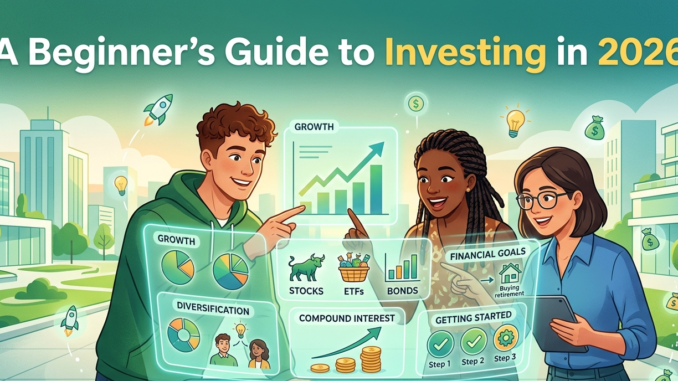
Investing has always been one of the most effective ways to build long-term wealth, but for beginners it can feel overwhelming. When I first started learning about investing several years ago, I remember feeling confused by the endless financial jargon—stocks, ETFs, index funds, diversification, market volatility, and more. It felt like everyone else already understood the rules of the game while I was just trying to figure out where to begin.
Fast forward to today, and the investing landscape has evolved significantly, especially as we move into 2026. Technology has made investing more accessible than ever before. Anyone with a smartphone can open an investment account, buy fractional shares, and track global markets in real time. However, accessibility does not always equal understanding. Many beginners still struggle with knowing what to invest in, how much to invest, and how to manage risk.
This beginner’s guide is designed to provide a clear, honest, and practical roadmap for anyone starting their investing journey in 2026. Instead of complicated theories, I’ll share lessons learned through real experience, common mistakes beginners make, and the strategies that can help build confidence and long-term financial stability.
Understanding What Investing Really Means
Before diving into specific strategies, it’s important to understand what investing actually means.
Investing is the process of putting money into assets that have the potential to grow in value over time. Unlike saving money in a traditional bank account where returns are usually small, investing allows your money to work for you through compounding growth.
Common investment assets include:
- Stocks
- Bonds
- Mutual funds
- Exchange-Traded Funds (ETFs)
- Real estate
- Cryptocurrencies
- Commodities
For beginners, the goal is not to become a financial expert overnight. Instead, it’s about building consistent habits, managing risk, and thinking long-term.
One of the most important lessons I learned early on is that successful investing is not about chasing quick profits. It’s about patience and discipline.
Why Investing Is More Important Than Ever in 2026
The financial world in 2026 looks very different compared to a decade ago.
Several factors make investing more important today:
1. Rising Inflation
Inflation gradually reduces the purchasing power of money. If your savings sit idle in a low-interest account, the real value of your money may actually decrease over time.
2. Increasing Cost of Living
Housing, healthcare, and education costs continue to rise globally. Investing helps people prepare financially for the future.
3. Digital Financial Tools
Investment platforms, robo-advisors, and financial apps now make it easier than ever for beginners to start with small amounts of money.
4. Long-Term Wealth Building
Investing is one of the few reliable methods for building wealth over decades rather than relying solely on income from work.
The First Step: Building a Strong Financial Foundation
Before investing a single dollar, it’s essential to build a strong financial foundation.
Many beginners skip this step and jump straight into the stock market, which can lead to unnecessary financial stress.
Create an Emergency Fund
An emergency fund should cover 3 to 6 months of living expenses. This money acts as a safety net for unexpected events such as job loss, medical emergencies, or urgent expenses.
Without an emergency fund, you may be forced to sell investments at a loss during difficult times.
Pay Off High-Interest Debt
High-interest debt—especially credit card debt—can grow faster than investment returns.
For example, if a credit card charges 20% interest annually, paying off that debt may provide a better financial outcome than investing.
Understanding Different Types of Investments
Once your financial foundation is stable, the next step is understanding where to invest.
Stocks
Stocks represent ownership in a company. When you buy a stock, you own a small portion of that company.
If the company grows and becomes more profitable, the stock price often increases.
However, stock prices can also fluctuate due to market conditions, economic changes, and company performance.
For beginners, it’s often safer to avoid investing in a single company and instead diversify.
Exchange-Traded Funds (ETFs)
ETFs are investment funds that contain a collection of stocks or other assets.
For example, an ETF might track the performance of the entire stock market or a specific sector such as technology or healthcare.
Many experienced investors recommend ETFs for beginners because they offer:
- Diversification
- Lower risk compared to individual stocks
- Lower management fees
Index Funds
Index funds are similar to ETFs but are usually structured as mutual funds.
They aim to replicate the performance of a market index such as the S&P 500.
Over the long term, index funds have historically delivered strong returns with relatively low costs.
This is why many long-term investors prefer them.
The Power of Diversification
Diversification is one of the most important principles in investing.
It simply means not putting all your money into a single investment.
When I started investing, I made the mistake of concentrating too much money into a single technology stock because it was popular at the time. When the stock price dropped, my portfolio suffered significantly.
That experience taught me the importance of spreading investments across different assets.
A diversified portfolio might include:
- Broad market ETFs
- International stocks
- Bonds
- Real estate investment funds
Diversification helps reduce risk because not all investments move in the same direction at the same time.
Long-Term Investing vs Short-Term Trading
Many beginners are attracted to day trading because it looks exciting on social media.
However, the reality is very different.
Short-term trading requires deep market knowledge, constant monitoring, and strong emotional discipline. Even professional traders often struggle to beat the market consistently.
Long-term investing, on the other hand, focuses on holding investments for years or even decades.
Historically, long-term investors who stay consistent tend to outperform those who constantly buy and sell.
Understanding Risk and Market Volatility
The stock market does not move in a straight line.
There will always be periods when markets decline. These fluctuations are known as market volatility.
During my early years of investing, the biggest challenge was not understanding numbers—it was managing emotions.
When markets fall, fear can cause investors to sell too quickly. When markets rise rapidly, excitement can lead to overconfidence.
Successful investors learn to stay calm during both situations.
One useful mindset is remembering that market downturns are often temporary. For long-term investors, they can even create opportunities to buy investments at lower prices.
The Role of Technology in Modern Investing
In 2026, technology plays a major role in investing.
Investment apps, robo-advisors, and AI-driven financial tools allow beginners to start investing with very small amounts of money.
Some platforms even automate portfolio diversification and rebalancing.
While these tools are helpful, it’s still important to understand the basics of investing rather than relying entirely on automation.
Technology should support your investment strategy—not replace your understanding.
Common Mistakes Beginner Investors Should Avoid
After observing many beginner investors and reflecting on my own journey, several common mistakes appear repeatedly.
Chasing “Hot” Stocks
Buying stocks simply because they are trending online can be risky.
Investing Without Research
Every investment decision should be supported by basic research and understanding.
Trying to Time the Market
Predicting market highs and lows is extremely difficult.
Lack of Patience
Investing is a long-term process, not a quick path to instant wealth.
Avoiding these mistakes can significantly improve long-term investment success.
Developing a Consistent Investment Habit
One of the most effective strategies for beginners is consistent investing.
Instead of investing a large amount at once, many investors contribute regularly—such as monthly.
This strategy is often called dollar-cost averaging.
It reduces the risk of investing all money during market highs and allows investors to gradually build their portfolio.
Over time, consistent contributions combined with compound growth can produce powerful results.
Final Thoughts
Starting your investment journey can feel intimidating, but it doesn’t have to be complicated.
Every successful investor begins as a beginner. What separates long-term investors from those who give up early is patience, education, and consistency.
In my own experience, the most valuable lesson has been learning to focus on the long term rather than reacting to short-term market movements. Markets will rise and fall, but disciplined investors who stay committed to their strategy often benefit the most over time.
Investing is not just about money—it’s about building financial freedom, security, and opportunities for the future.
Conclusion
Investing in 2026 offers more opportunities than ever before. With modern technology, accessible financial platforms, and a wealth of educational resources, beginners now have the tools needed to start building wealth earlier than previous generations.
However, successful investing still relies on timeless principles: patience, diversification, long-term thinking, and continuous learning.
If you’re just beginning your journey, remember that progress happens step by step. Start small, stay consistent, and focus on long-term growth rather than short-term speculation.
Over time, the habits you build today can shape a more secure financial future tomorrow.
Leave a Reply