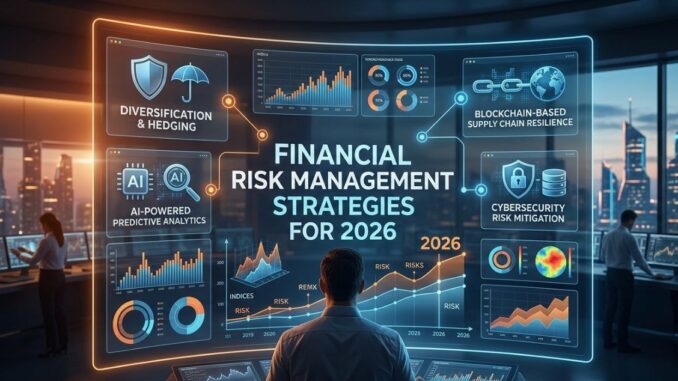
Introduction to Financial Risk in 2026

Let’s be honest — 2026 isn’t playing around.
The financial world feels like a roller coaster built by an engineer who loves surprises. Inflation waves, AI disruption, crypto volatility, geopolitical tensions — it’s a lot. If money were a ship, risk management would be your radar system. Without it? You’re sailing blind.
Why Risk Management Matters More Than Ever
Markets move faster than ever. News spreads in seconds. One tweet can shake billions in valuation. So the question is simple: Are you prepared?
Risk management isn’t about avoiding risk entirely. That’s impossible. It’s about controlling it, shaping it, and using it wisely.
Global Economic Trends Shaping 2026
In 2026, we’re seeing:
-
Persistent inflation cycles
-
AI-driven industry transformation
-
Stricter ESG regulations
-
Increased cybersecurity attacks
-
Volatile cryptocurrency markets
This means uncertainty isn’t temporary — it’s structural.
Understanding Financial Risk
Before managing risk, you must understand it.
Market Risk
This is the classic one. Stocks go up. Stocks go down. Interest rates change. Currency values fluctuate. It’s the heartbeat of the market — unpredictable but constant.
Credit Risk
This happens when borrowers fail to repay loans. Businesses and banks feel this heavily during economic slowdowns.
Liquidity Risk
Ever tried selling an asset quickly but couldn’t? That’s liquidity risk. In 2026, tight credit markets make this more dangerous.
Operational Risk
System failures, fraud, internal errors — sometimes the biggest risks come from inside.
Emerging Risks in 2026
AI and Automation Risks
AI is powerful, but what if algorithms fail? What if automated trading systems misfire? The more we rely on AI, the greater the operational risk exposure.
Cybersecurity Threats
Data is gold — and hackers know it. Financial institutions face increasing ransomware and digital theft attacks.
Geopolitical Instability
Trade wars, sanctions, political shifts — global instability impacts currency, supply chains, and investments.
Climate and ESG Risks
Companies ignoring environmental risks may face regulatory penalties or investor backlash. ESG compliance is no longer optional.
Core Risk Management Strategies
Diversification Strategies
Don’t put all your eggs in one basket. You’ve heard it before because it works.
Spread investments across industries, countries, and asset classes. If one sector crashes, another may rise.
Asset Allocation in 2026
Asset allocation is like designing a balanced diet for your money.
Traditional vs Alternative Assets
Stocks and bonds remain foundational. But alternative assets like real estate, commodities, and private equity are gaining attention.
Cryptocurrency Considerations
Crypto remains volatile. In 2026, it’s best treated as a high-risk satellite investment — not your core holding.
Hedging Techniques
Derivatives and Options
Options and futures contracts can offset potential losses. Think of them as financial airbags.
Insurance as a Risk Tool
Insurance isn’t just for health or cars. Businesses use insurance to transfer operational and liability risks.
Liquidity Management
Emergency Funds
Individuals should hold at least 6–12 months of expenses in liquid assets.
Businesses? Even more.
Cash Flow Planning
Positive cash flow is oxygen. Without it, even profitable businesses collapse.
Leveraging Technology for Risk Control
AI-Based Risk Monitoring
AI systems now analyze massive data sets in real time, detecting anomalies before humans can.
Predictive Analytics
Forecasting models help anticipate downturns and supply chain disruptions.
Regulatory Compliance in 2026
Global Financial Regulations
Governments worldwide are tightening regulations, especially in crypto and ESG sectors.
ESG Reporting Requirements
Investors demand transparency. Companies must disclose environmental and governance practices clearly.
Stress Testing and Scenario Planning
Building Financial Shock Absorbers
Run simulations. What happens if revenue drops 30%? If interest rates spike 2%?
Prepare now — panic later is expensive.
Worst-Case Scenario Modeling
Hope for the best. Plan for the worst.
Risk Management for Businesses
Enterprise Risk Management (ERM)
ERM integrates risk management across departments — finance, operations, HR, IT. No silos allowed.
Supply Chain Risk Mitigation
Diversify suppliers. Relying on one country or vendor is risky in today’s environment.
Risk Management for Individual Investors
Personal Portfolio Protection
Rebalance quarterly. Review exposure levels. Avoid concentration risk.
Retirement Risk Planning
Longevity risk is real. Plan for living longer than expected.
Behavioral Risk Management
Emotional Investing
Fear and greed are terrible advisors. Markets fall — don’t panic sell.
Avoiding Panic Selling
History shows markets recover. Emotional reactions lock in losses.
Risk Governance and Leadership
Role of CFOs and Risk Officers
Leadership must actively monitor risk metrics — not react only when crises hit.
Creating a Risk-Aware Culture
Everyone in an organization should understand risk exposure.
Insurance and Risk Transfer
Business Insurance Strategies
Cyber insurance, liability insurance, and business interruption coverage are essential in 2026.
Personal Protection Plans
Life, disability, and health coverage protect income streams.
Continuous Monitoring and Review
Quarterly Risk Reviews
Review portfolios and business risks at least every quarter.
Adaptive Risk Strategies
Markets evolve. Your strategy should too.
Conclusion
Financial risk in 2026 isn’t something to fear — it’s something to master.
Think of risk management like a seatbelt. You don’t wear it because you expect to crash. You wear it because crashes happen.
The winners in 2026 won’t be those who avoid risk completely. They’ll be the ones who measure it, manage it, and move forward confidently.
Control the risk — don’t let it control you.
FAQs
1. What is the most important financial risk in 2026?
Market volatility combined with geopolitical instability is among the most significant risks.
2. How often should risk strategies be reviewed?
At least quarterly, or immediately after major market events.
3. Is cryptocurrency too risky for 2026 portfolios?
It’s high-risk but can be included in small allocations for diversification.
4. Why is ESG important in risk management?
Regulatory and investor pressure make ESG compliance critical for long-term sustainability.
5. Can AI replace human risk managers?
No. AI enhances monitoring, but human judgment remains essential.
Leave a Reply