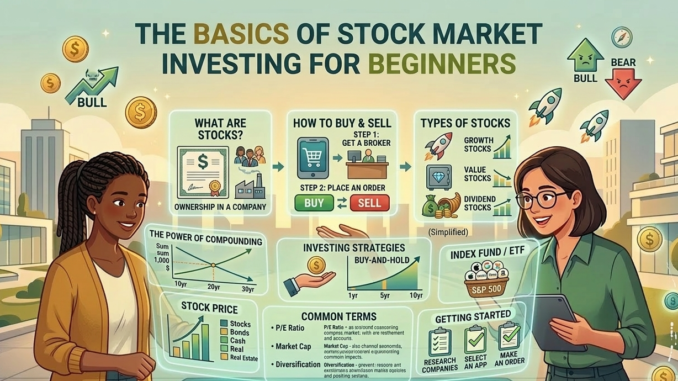
For many people, the stock market seems confusing at first. Words like shares, dividends, portfolios, and market volatility can make investing sound complicated or even intimidating. I remember when I first became interested in the stock market. Like many beginners, I had a lot of questions and very few clear answers. I wondered how ordinary people were able to invest, how they chose stocks, and whether investing was actually safe.
Over time, after reading financial books, following experienced investors, and making a few beginner mistakes myself, I started to understand that stock market investing is not as mysterious as it first appears. In fact, once the basic principles are understood, investing can become a practical and powerful way to build long-term financial security.
The goal of this guide is to explain the fundamentals of stock market investing for beginners in a clear and realistic way. Instead of focusing on complicated strategies, this article will walk through the basic concepts that every new investor should understand before entering the market.
This article is written from the perspective of someone who has spent years learning about personal finance and observing how disciplined investors approach the market. The intention is to provide reliable, trustworthy information that can help beginners start their investment journey with confidence.
Understanding What the Stock Market Actually Is
At its core, the stock market is a place where people buy and sell shares of publicly traded companies.
When a company decides to raise money for growth or expansion, it may offer ownership shares to the public. These shares are then traded on stock exchanges where investors can buy and sell them.
When you purchase a stock, you are essentially buying a small ownership stake in a company.
This means you may benefit from the company’s success in two main ways:
- Stock Price Growth – If the company grows and becomes more valuable, the share price may increase.
- Dividends – Some companies distribute part of their profits to shareholders in the form of regular payments.
Understanding this simple concept is the foundation of stock market investing.
Why People Invest in the Stock Market
People invest in the stock market for several different reasons, but the most common goal is long-term wealth growth.
Compared to traditional savings accounts, investments in stocks have historically provided higher returns over long periods. While markets can fluctuate in the short term, long-term investors often benefit from the growth of businesses and economies.
Some common financial goals that motivate investors include:
- Saving for retirement
- Building long-term wealth
- Protecting money against inflation
- Generating passive income through dividends
- Achieving financial independence
However, investing also involves risk, which is why understanding the basics is so important before putting money into the market.
How Stocks Are Bought and Sold
In the past, buying stocks required working directly with a stockbroker. Today, modern technology has made investing far more accessible.
Most beginners now start by opening an account with an online brokerage platform. These platforms allow investors to:
- Buy and sell stocks
- Invest in funds
- Track market performance
- Manage investment portfolios
Opening an investment account is often straightforward and can usually be done online.
Once the account is funded, investors can begin purchasing stocks or other investment assets.
The Difference Between Stocks and Funds
One common confusion for beginners is understanding the difference between individual stocks and investment funds.
Individual Stocks
When investors buy shares of a single company, they are investing directly in that business.
If the company performs well financially, the stock price may rise. If the company struggles, the stock price may fall.
While individual stocks can produce strong returns, they also carry higher risk if the investment is concentrated in only one company.
Index Funds and Exchange-Traded Funds
Many beginner investors prefer to start with index funds or exchange-traded funds (ETFs).
These funds hold shares of many different companies, providing automatic diversification.
Instead of betting on a single company, investors gain exposure to an entire section of the market.
For beginners, this approach can reduce risk while still allowing participation in market growth.
The Importance of Diversification
Diversification is one of the most important principles in investing.
It means spreading investments across different companies, industries, or asset types instead of concentrating money in one place.
For example, instead of investing all money in a single technology company, a diversified investor might hold investments across:
- Technology companies
- Healthcare companies
- Consumer goods companies
- Energy companies
- International markets
Diversification reduces the impact that any single investment can have on a portfolio.
When one sector struggles, another sector may perform better, helping balance overall performance.
Understanding Market Volatility
The stock market does not move in a straight line. Prices constantly change based on economic conditions, company performance, and investor sentiment.
These fluctuations are known as market volatility.
When I first began following the stock market, the daily ups and downs were sometimes stressful to watch. However, over time it became clear that volatility is a normal part of investing.
Short-term declines are common, but historically markets have tended to grow over longer periods.
Learning to stay calm during temporary downturns is one of the most important skills an investor can develop.
Long-Term Investing vs Short-Term Trading
Another important concept beginners should understand is the difference between long-term investing and short-term trading.
Long-Term Investing
Long-term investors buy investments and hold them for many years.
Their focus is on the gradual growth of businesses and the power of compound returns.
This approach generally requires less frequent trading and less emotional decision-making.
Short-Term Trading
Short-term traders attempt to profit from rapid price movements.
While trading may appear exciting, it requires significant experience, market knowledge, and discipline. Many beginners underestimate how difficult it can be to consistently succeed in short-term trading.
For most people starting out, long-term investing is usually the more reliable approach.
The Power of Compound Growth
One of the most powerful concepts in investing is compound growth.
Compounding occurs when investment returns begin generating additional returns over time.
For example, if an investment earns returns and those returns remain invested, the total value of the investment grows faster over time.
The earlier someone begins investing, the more time compounding has to work.
This is why many financial experts encourage people to start investing as early as possible, even if the initial investment amount is small.
Common Mistakes Beginner Investors Should Avoid
When people first begin investing, certain mistakes are very common.
Recognizing these mistakes early can help investors avoid unnecessary losses.
Trying to Time the Market
Many beginners attempt to buy stocks at the lowest possible price and sell at the highest point.
In reality, consistently predicting market movements is extremely difficult.
Investing Based on Hype
Online trends and social media discussions can sometimes push investors toward risky decisions.
Successful investing usually involves research and long-term thinking rather than reacting to popular trends.
Lack of Patience
Stock market investing rewards patience. Investors who constantly buy and sell based on short-term emotions often experience weaker results.
Building a Healthy Investing Mindset
Beyond financial knowledge, successful investing also requires the right mindset.
Over time, I’ve noticed that disciplined investors often share several common habits:
- They think long-term
- They remain calm during market volatility
- They focus on consistent investing rather than quick profits
- They continue learning about financial markets
These habits gradually build confidence and help investors make better decisions.
Final Thoughts
Learning the basics of stock market investing is one of the most valuable financial skills anyone can develop. While the market may seem complicated at first, understanding a few core principles can make the process much more approachable.
From my own experience, the most important step is simply getting started and continuing to learn over time. Investing is not about being perfect or predicting every market movement. Instead, it is about developing a thoughtful strategy and remaining consistent.
Financial markets will always experience periods of growth and decline. However, investors who stay patient and focused on long-term goals often benefit from the growth of the global economy.
Conclusion
The stock market offers individuals the opportunity to participate in the growth of businesses and economies around the world. While investing involves risks, it also provides one of the most effective ways to build long-term financial wealth.
By understanding the basics—such as how stocks work, the importance of diversification, the role of long-term investing, and the power of compound growth—beginners can approach the market with greater confidence.
Successful investing does not require perfect timing or complex strategies. Instead, it relies on consistent habits, thoughtful decision-making, and patience over time.
For anyone interested in improving their financial future, learning the fundamentals of stock market investing is an excellent place to start.
Leave a Reply