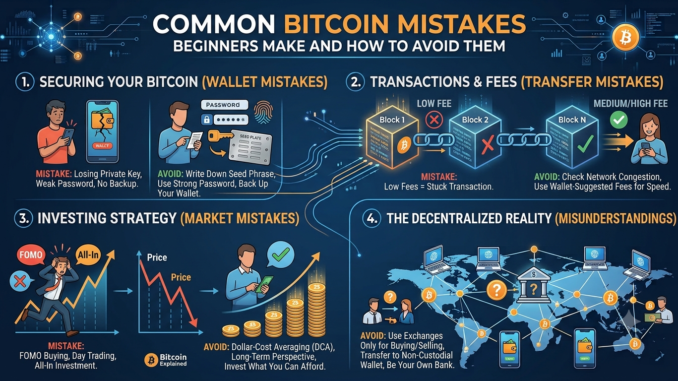
Entering the world of cryptocurrency is an exciting journey. The promise of financial freedom, cutting-edge technology, and impressive market gains draws millions of new investors to Bitcoin every year. However, because Bitcoin operates on a completely different set of rules than traditional banking, the learning curve can be steep.
In the crypto world, you are your own bank. While this financial sovereignty is empowering, it also means there is no safety net. A single mistake can lead to lost funds that cannot be recovered.
To help you navigate these waters safely, here is a comprehensive guide to the most common Bitcoin mistakes beginners make and exactly how you can avoid them.
1. FOMO Buying and Panic Selling
The emotional rollercoaster of cryptocurrency prices is one of the hardest things for beginners to manage.
- FOMO (Fear of Missing Out): When Bitcoin’s price is skyrocketing, news headlines and social media hype blow up. Out of fear of being left behind, beginners rush to buy at the absolute peak of the market.
- Panic Selling: Cryptocurrency markets experience frequent corrections. When the price inevitably drops, beginners panic, fear they will lose everything, and sell their Bitcoin at a loss.
How to Avoid It: Use DCA (Dollar-Cost Averaging)
Instead of trying to time the market or investing a huge lump sum all at once, use a strategy called Dollar-Cost Averaging (DCA).
With DCA, you invest a fixed amount of money at regular intervals (e.g., $20 every week or $100 every month), regardless of what the price is. When the price is high, your money buys less Bitcoin; when the price is low, your money buys more. Over time, this smooths out volatility and removes emotional decision-making from your investing habits.
2. Leaving Large Amounts of Bitcoin on Exchanges
When you buy Bitcoin on an exchange like Binance, Coinbase, or Kraken, the exchange holds the Bitcoin for you. This means they control the private keys (the digital passwords) to your funds.
History has shown that crypto exchanges can go bankrupt, suffer from catastrophic hacks, or abruptly freeze user accounts. The famous golden rule of crypto is: “Not your keys, not your coins.” If you don’t control the private keys, you don’t truly own the Bitcoin.
How to Avoid It: Move Wealth to a Private Wallet
Exchanges are great for buying and selling crypto, but they are not meant for long-term storage.
- For small amounts that you trade frequently, a reputable mobile software wallet (like Trust Wallet or BlueWallet) is fine.
- For larger amounts or long-term savings, invest in a hardware wallet (like a Ledger or Trezor). These are physical devices that store your private keys completely offline, making them immune to online hackers.
3. Poor Seed Phrase Management
When you set up a private crypto wallet, you are given a seed phrase (usually a random sequence of 12 or 24 words). This phrase is the ultimate master key to your funds. If your phone breaks or you lose your hardware wallet, typing this seed phrase into a new device is the only way to recover your Bitcoin.
Beginners often make two fatal errors with their seed phrase:
- They store it digitally (taking a screenshot, saving it in a phone memo app, or emailing it to themselves), making it vulnerable to hackers.
- They lose the paper they wrote it on, permanently locking themselves out of their own money.
How to Avoid It: Go Analog and Secure
- Never type your seed phrase into any digital device unless you are actively restoring a wallet.
- Write it down by hand on a piece of paper (or stamp it into a metal plate for fireproofing).
- Store multiple copies in secure, physical locations (like a home safe or a bank safety deposit box).
- Never share it with anyone. No legitimate support team or platform will ever ask for your seed phrase.
4. Sending Bitcoin to the Wrong Address
Bitcoin transactions are irreversible. Once a transaction is confirmed on the blockchain, nobody—not even a bank, a government, or Satoshi Nakamoto himself—can reverse it.
Bitcoin wallet addresses are long, complex strings of alphanumeric characters. A common beginner mistake is trying to type out an address manually and making a typo, or accidentally copying an address belonging to a different cryptocurrency (like sending Bitcoin to an Ethereum address). If you send coins to the wrong address, they are gone forever.
How to Avoid It: Double-Check and Test
- Always use Copy/Paste or QR Code scanning. Never type a crypto address by hand.
- Verify the bookends: Before hitting “Send,” manually check the first five characters and the last five characters of the address to ensure your clipboard wasn’t altered by malware.
- Send a test transaction: If you are moving a large amount of money, send a tiny amount first (like $2 worth). Once you verify that the small amount arrived safely in your destination wallet, you can confidently send the rest.
5. Falling for Scams and “Get-Rich-Quick” Schemes
Because Bitcoin is decentralized and digital, it attracts a high volume of scammers targeting uneducated beginners. Common scams include:
- Phishing Scams: Fake websites or apps designed to look exactly like your exchange or wallet provider, asking you to log in or enter your seed phrase.
- Impersonation Scams: Malicious actors on Telegram, WhatsApp, or X (Twitter) pretending to be customer support agents or famous crypto personalities offering to double your investment.
- Cloud Mining/Ponzi Schemes: Websites promising guaranteed high daily returns if you invest your Bitcoin with them.
How to Avoid It: Practice Extreme Skepticism
- If it sounds too good to be true, it is a scam. Bitcoin does not offer “guaranteed daily returns.”
- Bookmark the official websites of your exchanges and wallets, and only access them through those bookmarks.
- Understand that legitimate support agents will never message you first on social media, nor will they ever ask you to send them funds to “fix” an issue.
Summary Checklist for Bitcoin Beginners
To keep your investment safe, run through this quick mental checklist whenever you interact with the Bitcoin ecosystem:
| What to Do | What to Avoid |
| Use Dollar-Cost Averaging (DCA) to invest steadily. | Do not buy purely out of FOMO at all-time highs. |
| Transfer your savings to a hardware wallet. | Do not leave your entire crypto net worth on an exchange. |
| Write your 12/24-word seed phrase on paper. | Do not take screenshots or save seed phrases online. |
| Verify every address before clicking send. | Do not type wallet addresses manually. |
| Accept that crypto is a long-term game. | Do not fall for platforms promising guaranteed quick riches. |
By taking your time, prioritizing security over speed, and continuing to educate yourself, you can comfortably avoid these common pitfalls and confidently participate in the future of finance.
Leave a Reply