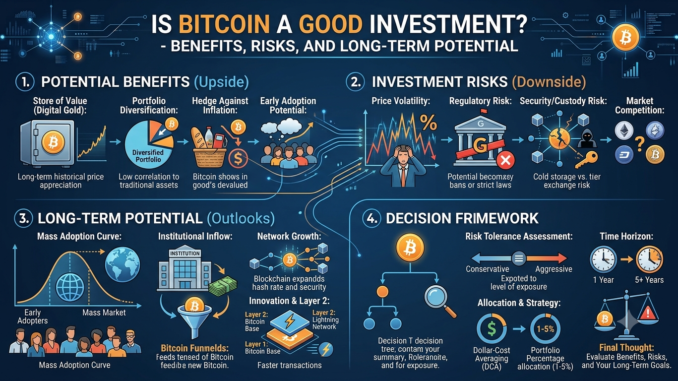
From a fringe internet experiment worth fractions of a cent to an institutional asset class, Bitcoin ($\text{BTC}$) has rewritten the rules of modern finance. Today, it stands as a unique, highly debated asset. Many view it as “digital gold”—a hedge against inflation and a revolutionary leap forward for money. Others see it as a speculative bubble driven purely by hype and volatile market cycles.
If you are wondering whether Bitcoin deserves a place in your investment portfolio, you need to understand both sides of the coin. This article breaks down the tangible benefits, the undeniable risks, and the long-term potential of investing in Bitcoin.
1. The Benefits of Investing in Bitcoin
Bitcoin possesses several unique structural characteristics that make it an attractive investment asset for both retail individuals and institutional funds.
- Absolute Mathematical Scarcity: Unlike fiat currencies (like the US Dollar or Euro), which central banks can print in infinite quantities, Bitcoin has a hard supply cap of 21 million coins. This absolute scarcity means that if global demand for Bitcoin increases over time, the fixed supply will naturally drive long-term price appreciation.
- Deepening Institutional Adoption: Bitcoin is no longer just for tech enthusiasts. The approval of Spot Bitcoin ETFs (Exchange-Traded Funds) has allowed pension funds, asset managers, and retail retirement accounts to legally and easily hold Bitcoin. Furthermore, public companies are increasingly adding billions of dollars worth of Bitcoin directly to their corporate treasuries as a long-term reserve asset.
- Asymmetric Return Potential: Historically, Bitcoin has been one of the best-performing assets of the past decade. Because it is still a relatively young asset class compared to the multi-trillion-dollar global gold or real estate markets, it retains a high ceiling for potential long-term growth.
- Liquidity and Sovereignty: Bitcoin trades 24 hours a day, 365 days a year on a global network. It is highly liquid, meaning you can convert it back into your local cash almost instantly. Because you can self-custody your Bitcoin in a private wallet, it cannot be seized, frozen, or devalued by a centralized banking institution.
2. The Risks of Investing in Bitcoin
While the upside can be massive, Bitcoin is not a guaranteed path to riches. It carries severe, unique risks that every investor must prepare for.
- Extreme Price Volatility: Bitcoin is notorious for dramatic price swings. It is common for Bitcoin to experience “crypto winters,” where the price drops by 50% to 80% from its previous peak before recovering. Investors without a strong stomach or long-term horizon often panic-sell during these crashes and lose money.
- No Underlying Cash Flow: Unlike buying a stock (which represents shares in a company that generates profit) or real estate (which generates rental income), Bitcoin does not produce cash flow or physical products. Its value relies purely on what the market believes it is worth—often referred to as Speculative Value.
- Macroeconomic and Regulatory Pressures: Bitcoin often moves in tandem with global economic shifts. For instance, when central banks adopt hawkish monetary policies (like raising interest rates to combat inflation) or when geopolitical tensions escalate, Bitcoin often trades like a high-risk tech asset, causing investors to temporarily pull out money. Additionally, shifting government tax laws and regulations create ongoing uncertainty.
- Irreversible Self-Custody Mistakes: If you lose your private keys or make an error sending funds across the network, your assets are gone forever. There is no bank customer helpline to undo an operational mistake.
3. Evaluating Bitcoin’s Long-Term Potential
To decide if Bitcoin is right for you, it is helpful to contrast how its mechanics function over different time horizons:
| Feature | The Short-Term Reality (1-12 Months) | The Long-Term Potential (5-10+ Years) |
| Price Behavior | Highly volatile, unpredictable, and easily swayed by news headlines or interest rate changes. | Historically driven by supply-side dynamics like the Bitcoin Halving (which cuts new daily supply in half every 4 years). |
| Primary Use Case | Used primarily by traders for short-term speculation and capital gains. | Evolving into a recognized global digital store of value, acting as an alternative to physical gold. |
| Market Outlook | Fluctuates based on temporary sentiment, moving quickly between zones of “Fear and Greed.” | Supported by structural scarcity and the steady expansion of institutional finance rails. |
Conclusion: Is It a Good Investment For You?
Bitcoin can be a powerful addition to an investment portfolio, but it is not a traditional asset. Whether it is a “good” investment depends entirely on your financial goals, your time horizon, and your personal risk tolerance.
The Golden Rules of Crypto Investing:
- Never invest money you cannot afford to lose. Due to its volatility, your Bitcoin position should represent a portion of your portfolio that won’t disrupt your daily survival if the market drops.
- Extend your timeline. Bitcoin reward cycles unfold over years, not weeks. Treating it as a multi-year savings vehicle rather than a get-rich-quick scheme reduces emotional stress.
- Keep learning. The more you understand the underlying blockchain technology, the less likely you are to panic during inevitable market downturns.
ဇာတ်ကားများ ကြည့်ရှုရန်
အောက်ကခလုတ်ကို နှိပ်ပြီး ဝင်ရောက်ကြည့်ရှုနိုင်ပါပြီ
Leave a Reply