The financial world changed forever in 2009 when an anonymous programmer (or group of programmers) using the pseudonym Satoshi Nakamoto released a whitepaper titled Bitcoin: A Peer-to-Peer Electronic Cash System.
Today, Bitcoin ($\text{BTC}$) is a household name, worth billions of dollars and driving a global financial revolution. Yet, for many beginners, it remains a mysterious and intimidating concept. What exactly is Bitcoin? How does it work? Is it real money?
This comprehensive guide breaks down everything you need to know about Bitcoin in plain, simple English.
1. What is Bitcoin?
At its core, Bitcoin is a digital currency (also known as cryptocurrency). Unlike traditional fiat currencies like the US Dollar, Euro, or Myanmar Kyat, Bitcoin does not exist as physical coins or paper bills. It lives entirely online.
What truly sets Bitcoin apart from traditional money are three core pillars:
- Decentralization: Traditional money is controlled by central banks and governments. Bitcoin, however, is not controlled by any single entity, company, or country. It is maintained by a global network of computers.
- Peer-to-Peer (P2P): When you transfer money digitally today, you usually need a middleman like a bank, Visa, or PayPal. Bitcoin allows you to send money directly to anyone, anywhere in the world, without needing a trusted third party.
- Scarcity: Governments can print more fiat currency whenever they want, which often leads to inflation. Bitcoin has a hard cap. There will only ever be 21 million Bitcoins created. This mathematical scarcity is why many refer to Bitcoin as “digital gold.”
2. How Does Bitcoin Work? (The Technology)
To understand Bitcoin, you don’t need to be a computer scientist, but you do need to understand two key concepts: The Blockchain and Mining.
The Blockchain: The Public Ledger
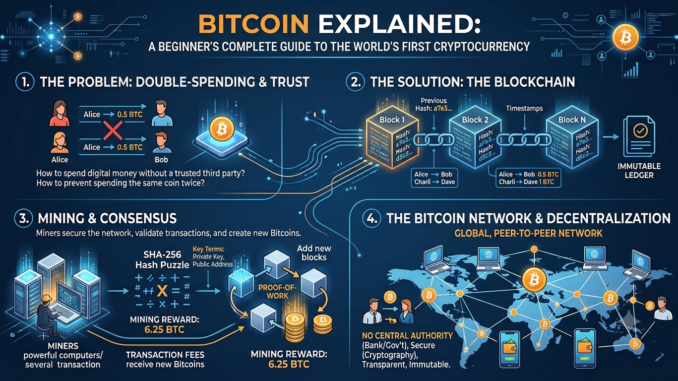
Imagine a giant, public notebook that records every single Bitcoin transaction ever made. This notebook is called the Blockchain.
Instead of being stored on one central server (like a bank’s computer), copies of this notebook are shared across thousands of computers worldwide (called nodes). Every time a transaction happens, it is grouped with other transactions into a “block.” Once verified, this block is added chronologically to the existing chain of blocks—hence, blockchain.
Because everyone has a copy of the ledger, it is practically impossible to cheat the system. If someone tries to alter a past transaction to steal Bitcoin, the rest of the network will instantly reject it.
Bitcoin Mining: How New Coins Are Born
Bitcoin doesn’t have a mint to print money. Instead, new bitcoins are created through a process called mining.
“Miners” use powerful, specialized computers to solve highly complex mathematical puzzles.
- The first miner to solve the puzzle wins the right to add the latest block of transactions to the blockchain.
- As a reward for their work and electricity spent, the miner is paid in brand-new, freshly minted Bitcoin.
What is the Halving?
To keep inflation in check, the reward that miners receive is cut in half every four years. This event is known as the Bitcoin Halving. It ensures that the supply of new Bitcoins slows down over time until the final Bitcoin is mined around the year 2140.
3. Key Concepts Every Beginner Must Know
If you are going to interact with Bitcoin, you will frequently run into these terms:
- Public Key (Your Address): This is like your email address or bank account number. It is a long string of letters and numbers that you give to people so they can send you Bitcoin. It is completely safe to share publicly.
- Private Key (Your Password): This is the cryptographic key that gives you access to the Bitcoin at your address. Never share your private key with anyone. If someone gets your private key, they can steal all your Bitcoin, and there is no “Forgot Password” button to recover it.
- Satoshis (Sats): You do not need to buy a whole Bitcoin. Just like a dollar can be broken down into cents, 1 Bitcoin can be divided into 100 million smaller units called Satoshis (or Sats). You can easily buy $10 or $20 worth of Bitcoin.
4. Pros and Cons of Bitcoin
Like any financial asset, Bitcoin comes with its own set of advantages and risks.
| Advantages of Bitcoin | Risks & Disadvantages |
| Financial Sovereignty: You have total control over your money. No bank can freeze your account. | High Volatility: Bitcoin prices can fluctuate wildly in a single day, making it a risky short-term investment. |
| Global & Fast: Send money across borders in minutes with relatively low fees compared to wire transfers. | Irreversible Transactions: If you send Bitcoin to the wrong address or get scammed, there is no customer support to get it back. |
| Inflation Hedge: Due to its fixed supply of 21 million, it cannot be devalued by government printing. | Regulatory Risks: Governments around the world are still deciding how to regulate or tax Bitcoin. |
5. How to Get Started with Bitcoin
If you are ready to take your first steps into the crypto world, here is the basic workflow:
Step 1: Choose a Crypto Exchange
An exchange is a platform where you can swap your local fiat currency for Bitcoin. Popular global exchanges include Binance, Coinbase, and Kraken. Always choose reputable, regulated platforms.
Step 2: Set Up a Wallet
While you can leave your Bitcoin on the exchange, it is much safer to move it to a personal crypto wallet where you control the private keys.
- Software Wallets (Hot Wallets): Apps on your phone or computer (e.g., Trust Wallet, MetaMask). Convenient for quick transactions but connected to the internet.
- Hardware Wallets (Cold Wallets): Physical devices resembling USB drives (e.g., Ledger, Trezor). They store your keys offline and offer the highest level of security against hackers.
Step 3: Practice Safe Habits
- Enable Two-Factor Authentication (2FA): Always secure your accounts using apps like Google Authenticator (avoid SMS 2FA).
- Write Down Your Seed Phrase: When you create a wallet, you will get a 12-to-24-word backup phrase. Write it on paper and hide it safely. Do not take a screenshot or save it online.
Summary: The Future of Money?
Bitcoin started as an experimental idea on an obscure internet forum. Today, it is recognized globally as a legitimate asset class. Major corporations hold it on their balance sheets, and some countries have even adopted it as legal tender.
Whether Bitcoin eventually replaces physical cash or remains a digital store of value like gold, one thing is certain: cryptocurrency and blockchain technology are here to stay. By understanding the fundamentals today, you are preparing yourself for the future of global finance.
Leave a Reply