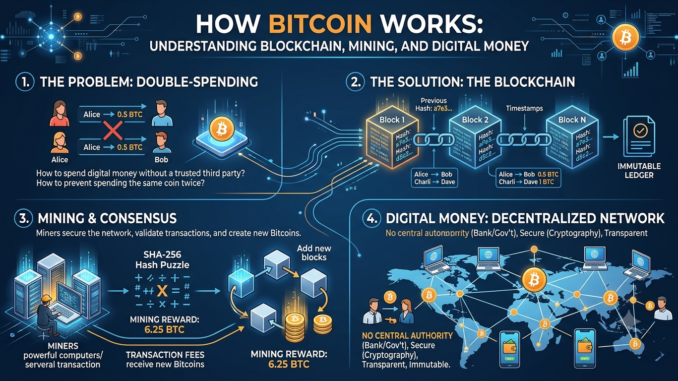
When Bitcoin was introduced to the world, it wasn’t just a new type of currency; it was a fundamental shift in how human beings transfer value. For centuries, our financial systems have relied on central authorities—banks, governments, and clearing houses—to maintain trust and keep track of who owns what.
Bitcoin completely removes the middleman. It introduces a trustless, transparent financial network governed purely by math and computer code.
To understand how this digital money works under the hood, we must explore the three core pillars that keep the network running: The Blockchain, Mining, and Asymmetric Cryptography.
1. Digital Money and the Double-Spending Problem
Before Bitcoin, digital money faced a massive engineering obstacle known as the Double-Spending Problem.
If you have a digital file—like a PDF or an image—you can send it to someone, but you still keep a copy on your computer. If digital money worked the same way, someone could simply copy and paste a digital dollar bill and spend it a thousand times over.
Traditionally, we solve this by using a centralized bank. When you send money to a friend via a bank app, the bank updates its private database: it subtracts the amount from your account balance and adds it to your friend’s.
Bitcoin’s breakthrough was solving this double-spending problem without a central authority. It achieves this by making the database public and distributing it to thousands of computers worldwide.
2. The Blockchain: A Shared, Permanent Ledger
At its core, the Blockchain is a shared digital ledger (a record-keeping book) that tracks every single Bitcoin transaction ever made, all the way back to the very first block in 2009.
Instead of being stored on a single computer at a bank, identical copies of this ledger are maintained on thousands of computers around the world, called nodes.
Here is exactly how a transaction gets recorded onto this ledger:
[User Initiates Transaction]
         │
         ▼
[Broadcasted to Global Network of Nodes]
         │
         ▼
[Grouped Together into a "Block"]
         │
         ▼
[Miners Validate via Mathematical Puzzle]
         │
         ▼
[Block Permanently Linked to the Chain]
Why is it Secure?
Each block in the chain is cryptographically linked to the one that came before it using a mathematical function called a hash. If a malicious actor tries to alter a transaction in an old block, the hash of that block changes.
Because the blocks are chained together, changing one block breaks the links to all subsequent blocks. The rest of the network nodes would immediately spot this discrepancy against their own copies of the ledger and reject the fraudulent change.
3. Bitcoin Mining: Securing the Network
Bitcoin doesn’t have a corporate office or employees to verify transactions. Instead, it relies on a process called Mining, which uses a consensus mechanism known as Proof of Work (PoW).
Miners are individuals or companies who run high-powered, specialized computer rigs (called ASICs). They perform two vital functions for the network:
- They group pending user transactions into a new block and verify that the senders actually have the funds they are trying to spend.
- They compete against each other to solve an incredibly complex mathematical puzzle generated by the Bitcoin software.
The puzzle is a trial-and-error guessing game that requires immense computational power and electricity. The first miner whose computer guesses the correct answer wins the right to officially add the new block to the public blockchain.
The Incentives: Block Rewards and Fees
Why do miners spend thousands of dollars on hardware and electricity to do this? Because they are financially incentivized:
- The Block Reward: For every block successfully added, the winning miner is automatically awarded brand-new, freshly minted Bitcoin.
- Transaction Fees: Miners also keep the small processing fees attached to every transaction included in that block.
The 10-Minute Rule: Bitcoin’s code automatically adjusts the difficulty of the mathematical puzzles roughly every two weeks. This ensures that no matter how many miners join or leave the network, a new block is found approximately every 10 minutes.
4. Keys and Digital Signatures: Owning Your Money
How do you actually prove that you own a specific piece of Bitcoin on this public ledger? This is handled by a branch of mathematics called Asymmetric Cryptography.
When you set up a Bitcoin wallet, the software generates a pair of cryptographic keys:
- The Public Key (Your Address): This is your public account number. It is safe to share with anyone. If someone wants to send you Bitcoin, this is the address you give them.
- The Private Key (Your Digital Signature): This is your ultimate password. It is stored securely inside your wallet app.
When you want to send Bitcoin to someone, your wallet uses your private key to generate a unique digital signature for that specific transaction. The network nodes look at the transaction, compare the digital signature with your public address, and verify mathematically that you are the rightful owner of those funds—all without ever seeing your actual private key.
Summary: A Trustless Financial Ecosystem
Bitcoin works because it replaces human trust with mathematical certainty.
- The Blockchain provides an unchangeable, transparent history of all transactions.
- Mining ensures that updating the ledger requires real-world physical energy, preventing fraud and securing the network.
- Cryptography guarantees that only the holder of the private keys can move the funds.
By combining these three technologies, Bitcoin operates as a self-sustaining, global digital currency that runs 24/7/365, completely independent of any central bank or government intervention.
Leave a Reply