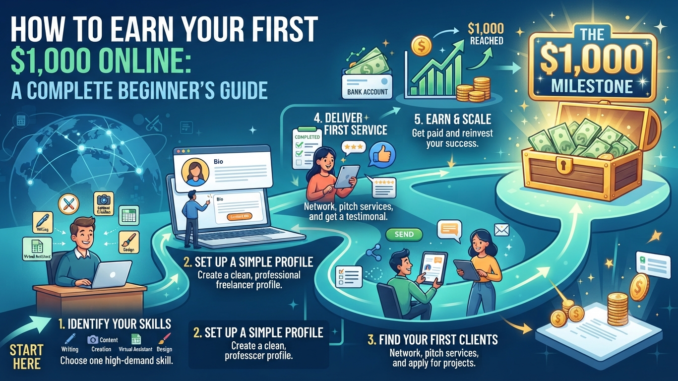
Earning your first $1,000 online is a monumental milestone. It shifts your mindset from “Can I actually make money on the internet?” to “How can I scale this?” For most beginners, the biggest hurdle isn’t a lack of intelligence or capability—it is information overload. With countless get-rich-quick schemes, conflicting advice, and shiny objects competing for your attention, it is easy to feel paralyzed.
This comprehensive, step-by-step guide cuts through the noise. We will not be exploring high-risk crypto trading, dropshipping with zero capital, or building a complex multi-vendor e-commerce empire. Instead, we will focus on practical, proven, service-based and digital-product models that require zero financial investment, leveraging skills you either already have or can learn within a few weeks.
Phase 1: The Mindset Shift and Choosing Your Path
Before diving into tactics, you must adopt the right philosophy. Making money online is not about tricking an algorithm or finding a secret loophole. Value creation equals income generation. If you want someone to give you $1,000, you must provide them with at least $3,000 worth of value, efficiency, or problem-solving.
To hit your first $1,000, you have two primary routes:
- The Service Route (Fastest): Trading your time, skills, and expertise for money. This is the most reliable way to make your first dollar online because businesses are already actively paying for these services.
- The Digital Asset Route (Scalable): Creating an e-book, a template, or a mini-course. While scalable, it is harder to do as a complete beginner because you lack an audience or trust.
The Recommendation: For your first $1,000, choose the Service Route. It requires zero ad spend, minimal setup time, and delivers fast cash flow.
Phase 2: Auditing Your Skills (What Can You Sell?)
You don’t need to be a rocket scientist to make money online. Look at what people and small businesses struggle with daily. They are busy, and they are willing to pay people who can take tasks off their plates or solve specific problems.
Here are the top high-demand, beginner-friendly skill categories:
- Content Writing & Copywriting: Writing blog posts, social media captions, newsletters, or high-converting sales emails.
- Graphic Design & Video Editing: Creating social media graphics using Canva, editing short-form videos (TikToks, Instagram Reels, YouTube Shorts) for creators.
- Virtual Assistance & Admin Support: Managing emails, scheduling appointments, customer service, or data entry.
- Social Media Management: Planning content calendars, responding to comments, and growing local business pages.
- Transcription & Translation: Converting audio files into text or translating documents between languages if you are bilingual.
Take a sheet of paper and write down everything you are even slightly better at than the average person. Are you organized? Do you have an eye for aesthetics? Can you write clearly? Pick one skill to focus on. Do not try to sell everything at once.
Phase 3: Setting Up Your Digital Shop Window
You don’t need a fancy website, a registered LLC, or an expensive logo to make your first $1,000. You just need a place where clients can see what you do and trust that you are a real, professional human being.
1. Optimize Your Social Media Profiles
Clients hire people, not logos. Turn your personal or professional LinkedIn, Twitter/X, or Instagram profile into a landing page:
- Clear Bio: State exactly who you help and how. (Example: “I help local cafes grow their Instagram presence through short-form video.”)
- Professional Photo: Use a clean, well-lit photo of your face smiling.
- Call to Action (CTA): Put your email or a direct message link in your bio so people know how to reach you.
2. Leverage Freelance Marketplaces (Optional, but Good for Practice)
Platforms like Upwork and Fiverr are saturated, but they still work well for beginners because the buyers are actively looking to spend money.
- Create a profile highlighting your chosen niche.
- Write proposals that focus entirely on the client’s problem, not on how great you are.
Phase 4: The Math of Your First $1,000
One of the reasons beginners fail is that they don’t break down their financial goal into manageable numbers. $1,000 sounds like a massive mountain when looked at as a single lump sum. Let’s break it down using different pricing models:
- The $1,000 Client: Land 1 client who pays you a retainer fee of $1,000/month for social media management or monthly blog writing.
- The $500 Client: Land 2 clients who pay you $500 each for a logo redesign, a basic website setup, or a bundle of video edits.
- The $100 Client: Land 10 clients who pay you $100 for a quick task, a single article, or a set of graphic templates.
- The $50 Client: Land 20 clients (this is harder to manage due to high volume, but great for building a portfolio).
As a beginner, aiming for two $500 projects or one $1,000 monthly retainer is the sweetest spot. It requires fewer clients, meaning you can focus deeply on delivering exceptional quality.
Phase 5: Outreach – How to Find Your First Paying Clients
This is where 95% of people quit because they are afraid of rejection. You must actively hunt for clients. They will not magically find your profile on day one.
1. Warm Outreach (Your Inner Circle)
Never underestimate the power of your existing network. Post on your personal Facebook, LinkedIn, and Instagram accounts:
“Hey everyone! I’m expanding my freelance work into [your niche, e.g., video editing for content creators]. If you or anyone you know is looking for help editing Reels or TikToks, let me know! I’m taking on 2 new clients this month. I’d love to chat.”
You would be surprised how often a friend, a former colleague, or a relative knows someone who needs your exact service.
2. Cold Outreach (Targeted Pitching)
Find local businesses, small online brands, or creators who have a weak spot in their digital presence (e.g., they haven’t posted on Instagram in 3 months, or their website blog hasn’t been updated since last year).
- Send them a short, polite, personalized message or email.
- The Structure: Compliment something they are doing right $\rightarrow$ Point out one area of improvement (value bomb) $\rightarrow$ Offer a quick solution $\rightarrow$ Ask if they want help.
3. Community Engagement
Join Facebook Groups, Reddit communities, or Discord servers where your target clients hang out. Do not spam your links. Instead, answer questions thoroughly and help people for free. When you establish authority, people will naturally message you asking, “Hey, can I hire you to do this for me?”
Phase 6: Over-Delivering and Securing the Bag
Once a client says “Yes” and agrees to work with you, your primary goal shifts from getting money to retaining and impressing them.
- Communication is King: Reply to messages promptly. If a project takes 3 days, update them on day 2. Clients hate being left in the dark more than they hate minor delays.
- Under-promise and Over-deliver: If you say you will deliver 3 graphics, give them 4. If you promise a turnaround time of 5 days, deliver it in 4.
- Ask for Testimonials: Once the project is successfully completed and the client is happy, ask: “I’m trying to build my portfolio—would you mind leaving a quick 2-3 sentence review about your experience working with me?” These reviews are your golden ticket to landing your next client twice as fast.
Phase 7: Scaling Beyond the First Grand
Congratulations! Once that $1,000 hits your bank account, take a moment to celebrate. You have officially proven that the internet is an ATM if you know how to insert the right code.
To go from your first $1,000 to your first $5,000 and beyond, follow these transition steps:
- Raise Your Prices: Now that you have social proof, portfolio pieces, and confidence, stop charging beginner rates. Double or triple your prices for your next clients.
- Turn One-Time Projects into Subscriptions: Instead of a one-off website design, offer a monthly maintenance package. This creates predictable, recurring monthly revenue (MRR).
- Refine Your Process: Automate your invoicing, contract signing, and client onboarding using free tools like Calendly, Google Docs, and PayPal or Stripe.
Final Thoughts
Earning your first $1,000 online is less about finding a secret blueprint and more about consistency, resilience, and taking imperfect action. Stop reading guides, close the browser tabs, pick one skill, and send your very first client pitch today. Your future online business starts with that single step
Leave a Reply