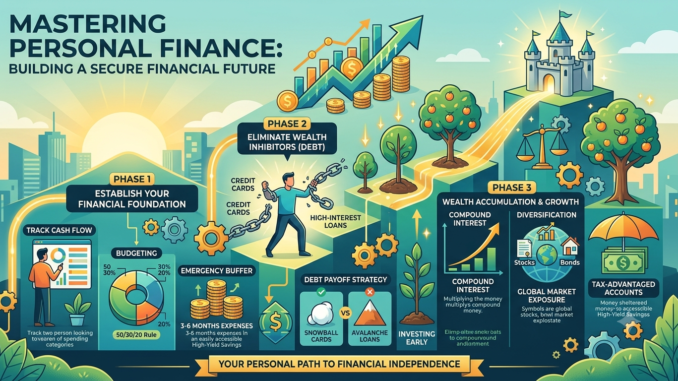
Financial freedom is rarely the result of a sudden windfall. Instead, it is built through intentional choices, strong financial discipline, and a clear understanding of how wealth accumulates over time.
Mastering personal finance requires moving beyond basic saving habits to adopt a proactive approach to managing, growing, and protecting your money.
Phase 1: Establish Your Financial Foundation
Before jumping into complex investment strategies, you must construct a rock-solid foundation.
1. Track Your Cash Flow
You cannot manage what you do not measure. Understanding the exact movement of your money is the first step toward financial control.
- Income vs. Cash Outflow: Calculate net income (after taxes) and categorize every recurring expense.
- Identify Leaks: Small, unmonitored daily expenses (subscriptions, frequent dining out, impulse purchases) quietly drain wealth over time.
2. Construct a True Emergency Buffer
An emergency fund is your defense against life’s uncertainties. It prevents you from liquidating long-term investments or taking on high-interest debt when unexpected events occur.
| Emergency Fund Stage | Goal | Recommended Account Type |
| Starter Fund | $1,000 – $2,000 | High-Yield Savings Account (HYSA) |
| Full Safety Net | 3 to 6 Months of Essential Living Costs | Liquid, low-risk account |
| Advanced Buffer | 6 to 12 Months (for freelancers/single-income households) | Short-term Treasury Bills / Money Market Funds |
Phase 2: Eliminate Wealth Inhibitors (Debt Management)
Debt directly diminishes your capacity to build wealth. Not all debt is created equal, but high-interest debt acts as a financial anchor.
       [ High-Interest Consumer Debt ]  <-- Eliminate Immediately (Credit Cards, Personal Loans)
                    │
                    ▼
       [ Low-Interest Secured Debt ]    <-- Manage Strategically (Mortgages, Low-Rate Student Loans)
- Prioritize High-Yield Liabilities: Any debt carrying an interest rate higher than expected market returns (typically > 7-8%) should be paid off aggressively.
- Automate Payments: Avoid late fees and credit score damage by automating minimum payments while manually directing excess cash flow toward the target balance.
Phase 3: Wealth Accumulation & Asset Allocation
Once liabilities are controlled and a safety net is in place, focus shifts toward asset growth.
1. Leverage Compound Interest Early
Time is the single most important factor in investing. Through compound growth, earnings generate their own earnings.
$$\text{Future Value} = P \times (1 + r)^n$$
Where:
- $P$ = Principal amount
- $r$ = Annual interest rate (or expected return)
- $n$ = Number of compounding periods (years)
2. Core Investment Vehicles
- Low-Cost Index Funds & ETFs: Provide instant exposure to broad markets (e.g., S&P 500 or Total World Stock Indices), reducing individual stock risk while keeping management fees near zero.
- Tax-Advantaged Accounts: Always maximize contributions to tax-sheltered accounts (e.g., workplace retirement plans, IRAs, or local tax-deferred equivalents) to keep more of your returns.
- Asset Diversification: Maintain a balanced portfolio across equities, fixed income, real estate, and cash according to your risk tolerance and age horizon.
Phase 4: Long-Term Protection & Optimization
Building wealth is only half the battle; protecting it ensures long-term security.
- Adequate Insurance Coverage: Protect your income and assets with adequate health, disability, property, and life insurance.
- Inflation Resistance: Cash sitting in a standard checking account loses purchasing power every year. Keep only operational money in cash; deploy the rest into growth assets.
- Periodic Portfolio Rebalancing: Review your portfolio annually to realign your asset allocation with your current goals and risk tolerance.
Key Takeaway
Mastering personal finance is a marathon, not a sprint. By focusing on cash flow awareness, eliminating bad debt, and consistently investing in diversified assets, you build a sustainable path toward lifelong financial independence.
ဇာတ်ကားများ ကြည့်ရှုရန်
အောက်ကခလုတ်ကို နှိပ်ပြီး ဝင်ရောက်ကြည့်ရှုနိုင်ပါပြီ
Leave a Reply